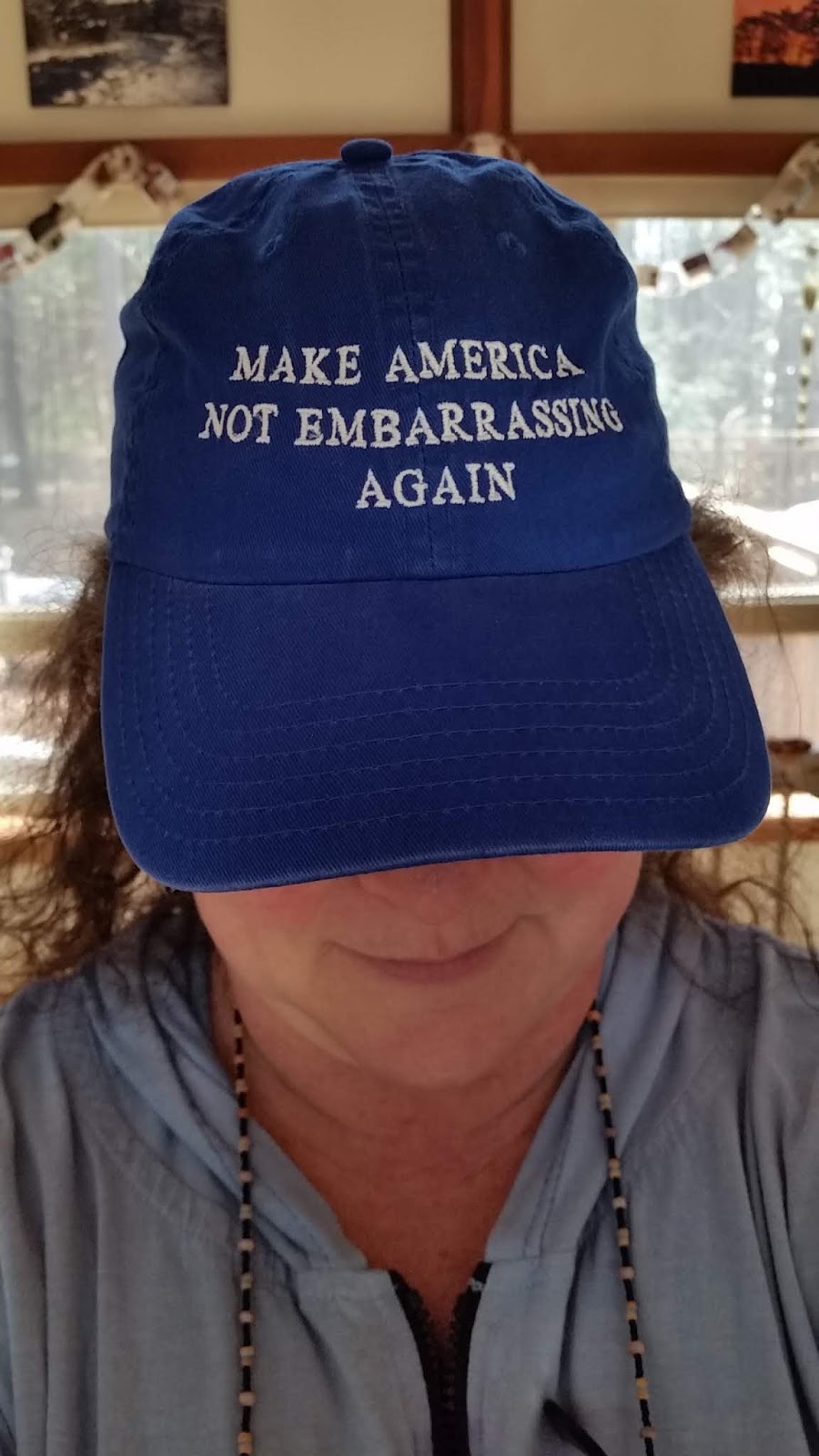
It is my belief that we do not have a fundamental right to pilfer and plunder our natural world, and that what we do have is a fundamental responsibility to do what we can to protect our planet's waters, soils, air, and the diverse wildlife that we share these resources with. The former does not ensure economic prosperity for all; the latter does. When one learns that certain actions have consequences--say, that morning coffee ritual from a business that heavily uses styrofoam cups, a product that simply and effectively trashes the earth--is there not only one ethical and moral thing to do? To start buying coffee from a business that does more for the environment? Change is necessary if we care about all the generations behind us--human and wildlife alike. But change is a complicated thing.

Therein lies the conundrum.

My pledge: to embrace change, and to find solutions to the conundrum.


Monday, March 11, 2019

Palm Sugar, Palm Oil, Palm ?

Workers unload trucks of harvested oil palm fruit at the PT Perkebunan Nusantara plantation and production factory in Kertajaya, Banten Province, Indonesia, on Monday, June 20, 2011. PT Perkebunan Nusantara VIII is a state-owned palm fruit plantation and palm oil factory. Photo Credit: Dadang Tri/Bloomberg/Getty Images

A casual line in a t.v. series we're watching suggested palm sugar is a problem in the world. It's not. Palm OIL most definitely is. Did you know? Palm oil surpasses soy oil production worldwide, and most of it (~90%!) comes solely from rainforests in Indonesia and Malaysia.

It's challenging being a conscientious consumer. One has to scrutinize labels on food products (not to mention cosmetics and shampoos/soaps, etc.), and be able to decipher the varying names and chemical states that palm oil and palm kernel oil hide under. But, palm oil consumption is having a staggering effect on rainforests and wildlife--orangutans especially; I'll take peace of mind over time-consuming shopping any day.

'Orangutan Foundation International Australia' has excellent info on how to determine palm oil content when it's hidden under the guise of "vegetable oil": https://orangutanfoundation.org.au/palm-oil/

This photograph, taken on February 24, 2014 during an aerial survey mission by Greenpeace at East Kotawaringin district in Central Kalimantan province on Indonesia's Borneo Island, shows cleared trees in a forest located in the concession of Karya Makmur Abadi which is being developed for a palm oil plantation. Environmental group Greenpeace on February 26 accused US consumer goods giant Procter & Gamble of responsibility for the destruction of Indonesian rainforests and the habitat of endangered orangutans and tigers. Photo credit: Bay Ismoyo/AFP/Getty Images


Tuesday, February 26, 2019

Film: Living in the Future's Past

Every once in a while a documentary comes along that is worth adding to the personal collection. Living in the Future's Past is once such doc.  Three of us went to see it.  We each appreciated it for it's beautiful photography, Jeff Bridges' narration, and for the diverse scientific and philosophical insights provided by the numerous expert speakers.


One of us, a former high school teacher and long-time volunteer for a local, school-age natural history program, thought it was a bit repetitive in places.  Another, a former State diplomat (aka Foreign Service Officer) turned conservationist, thought it was very focused on the human condition and human responses to the problem of why we do what we do.  And, I, a long-time naturalist with a B.S. in environmental studies, loved it's appeal to systems thinking from start to finish (but agreed it reiterated messaging heavily in the last quarter of the film.  I argued that this might have been intentional given the attention span of people in a general audience).  I fully plan on seeing it a 2nd time when my DVD arrives (via Amazon, unfortunately).

"In this beautifully photographed tour de force of original thinking, Academy Award winner, Jeff Bridges shares the screen with scientists, profound thinkers and a dazzling array of Earth’s living creatures to reveal eye-opening concepts about ourselves and our past, providing fresh insights into our subconscious motivations and their unintended consequences.

Living in the Future's Past shows how no one can predict how major changes might emerge from the spontaneous actions of the many.  How energy takes many forms as it moves through and animates everything.  How, as we come to understand our true connection to all there is, we will need to redefine our expectations, not as what we will lose, but what we might gain by preparing for something different."


Tuesday, November 6, 2018

Pathological Consumption..."All along the way we are bumping up against limits."

On Saturday, I attended a full-day professional writing seminar hosted by the The OpEd Project and held at the newly named Simmons University in Boston (formerly Simmons College).  The course was entitled, "Writing to Change the World."  So, here goes.

This past week, a Facebook survey hit my feed asking whether the social media giant's service was of benefit to the world (which first appeared at least two years ago but has been seen regularly by users since January this year).  I responded "disagree," because my immediate consideration was its role in being an easy platform for hateful and divisive people to exploit their First Amendment rights.  Yes, it's also a way for caring and mindful people to share the insights of superb movers and shakers, such as Annie Leonard, the founder of The Story of Stuff Project, whose varied informational videos are thorough and detailed and worth every minute, and George Monbiot, the prolific journalist whose deep reads on the environment and natural world should be mandatory in every developed nation's schools.  The ramifications, though, of the hatemongers slipping through the cracks will forever undermine all that good stuff.  Lack of prevention of the very thing that landed Mr. Zuckerberg in the hot seat last summer--bots and fake accounts--has cost us greatly as a nation.  Even with their six-part, 23-subsection 'Community Standards', I think we all sense Facebook's failure in being as beneficial as Zuckerberg thinks it is.  Check out their statement pertaining to false news; have you ever observed "promotion of news literacy" in your feed?

Speaking of Monbiot and Leonard, today I re-read an oldie but goodie by Monbiot that a couple of friends happened to share on Facebook recently: his 2012 piece called 'The Gift of Death' in which he succinctly frames how we are trashing the living world at rates crazier than ever and all for nothing but stuff...junk.  "Pathological consumption has become so normalized that we scarcely notice it."  Our consumerism is rendered so normal by advertising and the media that we scarcely notice what has happened to us and our planet.

I also watched Leonard's Story of Stuff video for the fourth or fifth time since having first seen it in my Systems Thinking course at UNH in early 2008.  It, too, surfaced in my Facebook feed today.  (Too bad Facebook's survey didn't land in my feed today.)  Leonard's storytelling is clear and concise, and I can't recommend enough her 21-minute video on how our system of consumerism is a system in crisis, and one in which we "are bumping up against limits at every turn."

As we approach the holiday season and the pressure of gift-giving, please consider Leonard's Story of Stuff and Monbiot's insight (both of whom had originally shed their insight in the month of December of their respective years).  Instead of buying even more stuff for your friends and loved ones, "bake them a cake, write them a poem, give them a kiss, or tell them a joke, but for god’s sake stop trashing the planet to tell someone you care. All it shows is that you don’t."


Thursday, May 17, 2018

Seven Years in Pictures -- Spring Edition

2012

23rd Annual Nonpoint Source Pollution Conference Great Bay Estuary NH/ME
Dr. Fred Short speaking on his eelgrass decline research. Below, one of the Estuary's primary bridges that, as it degraded over time, leached heavy metals into the water below.

On a personal note, perennial beds at home got converted into raised vegetable beds. A shitload of labor went into this for what proved to be a fairly short stint at growing our own fruits and veggies. Good thing there are lots of local farmers' markets around us. ;)

2013

Because every clothesline should have more than one purpose.

Red-backed salamander in the backyard. These little guys are an abundant species of salamander in NH. They, unlike their brethren,  are not aquatic. Rather, they love moist woodland floors and downed, decomposing woody debris. Leave those logs where they fall. :)

Eastern Yellow Swallowtail on Sargentii crabapple blossoms

2014

How to climb a stone wall like an Eastern Garter snake....
One of several watershed management/conservation signs installed around our town in areas where stormwater runoff has direct impacts on receiving water bodies such as the Winnicut River. This sign educates the reader about aquatic species and their habitat, and non-point source pollution (road/bridge/parking lot storm runoff...dog waste in the landscape...).
What is a watershed? From a bird's eye view, the area of land that drains to a receiving water body. Scale can be small--all the land in a town that drains to a lake...or large--a section of the country that drains into a system such as the Mississippi River. Imagine the contours of land and you'll start seeing how every stream, river, pond and lake eventually all leads to our oceans and seas.

One of the many fine examples of rock at the Natural History Museum in Boston, this is Labradorite from Madagascar.

2015

That bridge from 2012? In this pic it's in the distance, to the right of the setting sun, which, obviously, is in the west. In the previous picture we were heading east toward the bridge. The Piscataqua River is extensive as it drains the Great Bay Estuary and its seven tributaries.
Ichneumonid wasp! Zoom in to see its inch-long tail!

Freshwater Sunfish nest! Very shallow area while kayaking Lovell Lake in NH. Zoom in and look closely to see the actual male fish in the center, guarding his nest.

Eastern Painted turtle being returned to a freshwater body from whence it came, which included a Great Blue heron rookery (below right) 


Brand new toy--trash grippers! Great for walking and kayaking. :)

More work for river conservation, this time planting dozens of shrubs and tree stock. Volunteers make fast work when they number this many.
A good friend is a state-licensed wildlife rehabilitator. Here, a state endangered Blanding's turtle is being released after intensive care following a car strike. Note the transmitter for monitoring.

2016

Ocean debris turned into art. Sad and amazing at all once.

Those raised veggie beds didn't last long. Old dog needed a grassy area to roll around on...haha.

2017 - The Year of Marching


Climate March, D.C. April 27

Science March, NH April 22

Tax Day March, NH April 15

   
EPA/Save the Environment rally, Portsmouth NH April 8

And, of course, the Women's March in January. Pic not included here due to it having been a winter march and therefore out of purview.

2018 - The Year of Memes and Other Notables


DNA testing, anyone?


Portsmouth, NH March 24
'May our horror over your senseless deaths inspire us to demand sensible firearms reform'
Over three thousand people (below) came to rally in support of the Parkland School victims on this day


Friday, September 16, 2011

Eggplants and Insects

Naughty little conehead eating my eggplant leaves!  Must say, it was too impressive to do anything but take pictures of it.  :~)  Favorite bug ID website here.

Busy little bumblebee collecting precious stores of pollen from my eggplant flowers (which are a bit more intense in coler due to adjusting tonal levels with my picture software).  Look at those bundles of pollen on its quarters!  Did you know that bees pack pollen grains into the tiny hairs on their back legs?  Pollen baskets!  They feed their young with pollen.  :~)

Tuesday, September 6, 2011

Black Swallowtail Butterfly

The easiest way to distinguish Black Swallowtails from Spicebush Swallowtails (the two species that are most often confused, especially if you don't have the plants, and thus caterpillars, to rely on--as those are quite different) is by the yellow spotting on the topside wings.  Black Swallowtails have yellow spotting ABOVE the blue, while Spicebush's is typically below the blue, if at all present!  'Course, that's the case with the males, anyway.  Females are a whole different thing (but aren't we always!  Ha!).

There are lots of great sites online to check into when looking for butterflies.  But you probably already know this.

Have a great day -- thanks for visiting!
Hanging annual (in NH, anyway) is Lantana.

Sunday, August 21, 2011

Double-duty clothesline


...Years of having to deal with the plastic carried in by various family members and dinner guests (who seemingly have an inexhaustable supply) has led to the ultimate use of my clothesline.  For the ziplocs, a few years ago I had hubby drill some holes in squares of stone blocks (he's in the trade; use wood if you attempt the same), which I then stuck 3/16th dowels into.  Drill at a slight vertical angle all the way around the perimeter of the block.  There are more glamorous versions online if you look hard enough.  I, however, am all for Yankee ingenuity.

Need a reason to avoid plastic?  Read this.  Or this...
From the west-coast group, Algalita Marine Research Foundation, working to protect oceans from plastic pollution.  Click on the picture to see the whole 'Plastics Are Forever' educational brochure.
   

Saturday, July 23, 2011

1st Day of Leo

Sunflowers and amaranthus grown and arranged by Abe Zacharias of Zach's Farm in York, ME 
Love these spires!  Did you know that amaranthus comes in dozens of varieties, and that some have been grown for grain for more than 8000 years?
Beautiful!

Friday, July 8, 2011

What I'm reading...


An excerpt (pp 187-188):

“We must…rebuild the bottom of the food chain we have already lost by restoring the habitats where forage fish are born and reared.  Estuaries and river systems are vital zones of food production and not simply “natural” spaces.  Nearly every wild fish highlighted [in the book Four Fish]—striped bass, European sea bass, cod, Alaska Pollock, Atlantic and Pacific salmon, bluefin tuna—depends upon a supply of forage fish whose life cycles are in turn dependent upon rivers and estuaries.  Herring, menhaden, smelt—all these small fish are the silver coin, the coin of the marine realm, and their hatching and rearing often occur in direct association with access to rivers that enter the sea.  Restoring these areas increases the food supply for the fish we eat most.  Deny the restoration and…abundance will inevitably be limited by a low ceiling of limited food.”

Paul Greenberg, Author of Four Fish
2010, The Penguin Press

Friday, June 17, 2011

Precursor to Celebrating the Summer Solstice

The Mountain from TSO Photography on Vimeo.

Giant Ichneumon Wasp - Megarhyssa macrurus

I nearly bumped into one of these this morning while outside watering deck plants. An incredible flying wasp-like insect with a phenomenally long tail (ovipositor -- for egg laying). Ran inside for the camera, searched in vain for a shot. It was gone. After researching on one of my favorite bug sites, found its name, and then searched further online to come across this "microphotography" of females in action out in Illinois. Great pictures, and a wonderful summary to go with them! Awesome!

Tuesday, May 3, 2011

Life is Good

Red-bellied woodpeckers are courting, chickadees are building their nest, orioles and yellow-rumped warblers are in the canopy, and hummers are at the feeders.  And our peas have sprouted.  Life is good!

Snags are good.  This tree is used in spring and summer by red-bellied woodies for nesting, and in winter by bluebirds

Chickadee nest building began Sunday, May 1, 2011


unrefined wool from Riverslea Farm makes for perfect nesting material for all kinds of songbirds


Oak-hickory-birch canopy...buds are just popping (May 3, 2011) and attractive to orioles, warblers, grosbeaks....


orioles love grape jelly and oranges


Our hummer's favorite feeder.  Make your own solution: 1 part sugar to 4 parts water.  Dissolve over low heat, COOL before adding to feeder, change every third/fourth day depending on temperature/sun exposure.  Clean feeders are essential to the health of hummers!


'Super sugar' snap pea sprouts.  Can't wait for these babies to start climbing!